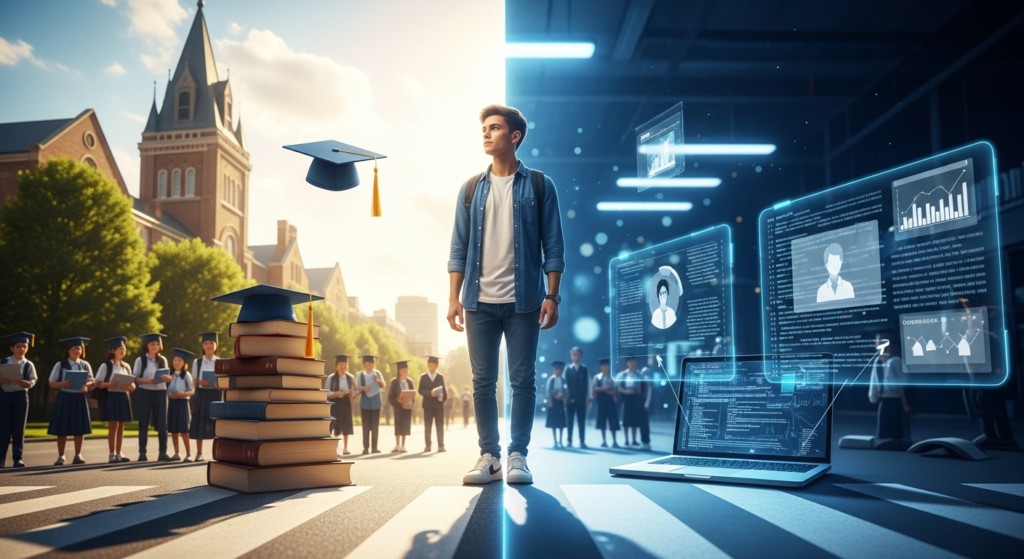

The education scenario in 2026 is changing drastically. The debate of the skill-based education system versus the traditional degrees has never been more topical than now due to the rapid technological progress, the evolving needs of the job market, and the emergence of online learning platforms. Students, employers and even educators are reconsidering what exactly is success in the modern world. Does a college education remain the golden ticket or are practical skills important?
Knowledge of Traditional Degrees.
The traditional degrees have been at the core of most education systems in the world. Colleges and universities provide programs that are planned, which emphasize theory, critical thinking, and academic level. The importance of degrees in engineering, medicine, law and business is still important.
Benefits of Traditional Degrees.
The conventional degree is credible and well known. There are numerous careers that are not achieved without education and certification. Universities also present the chance of networking, exposure to a variety of subjects and an all round learning experience. Besides, degrees are also commonly used as a filtering device by employers particularly in the competitive industries.
Disadvantages of Traditional Degrees.
Nevertheless, conventional education is not always in line with the trends of the industry. The curriculums do not necessarily match the real world and thus there is a disparity between the knowledge and the practice. The high tuition costs and time are also of great concern. Sometimes, it may not be worth waiting years to get a single degree because the world is changing rapidly and that may not necessarily prepare me to work.
Skill-based Education Emergence.
The education based on skills is aimed at practical knowledge and experience as well as job-related skills. The method has become popular because of online learning platforms, bootcamps, and industry-based certifications.
The Reason Skills are Becoming Important.
Employers in 2026 are emphasizing on what applicants are capable of doing instead of what they have learned. Coding, digital marketing, data analysis, content creation, and AI tools are some of the demanded skills. Business organizations are setting more importance on portfolios, real projects, and experience.
Skill-based learning is affordable and more flexible as well. Students are able to study at their own speed, select courses that are of interest and revise their knowledge on a regular basis. This is very appropriate to the current workforce where continuous learning is the order of the day.
Problems of Skill-Based Education.
Skill-based learning is not very standardized although it is advantageous. It is not true that every certification holds the same value and quality may be different on different platforms. Also, a lack of a systematic track can lead to the confusion of the learners or deprivation of the underlying knowledge.
The Real Thing Employers Will Need in 2026.
The employment environment has changed a great deal. The employers are seeking a blend of education and skill. Although degrees still count in some areas, real world expertise usually prevails.
Companies are focusing on:
- Problem-solving abilities
- Communication skills
- Flexibility and open-mindedness.
- On-the-job project experience.
In most sectors, candidates of high caliber in terms of skills and experience are performing better than those with degrees and very little practical exposure. Particularly startups and tech companies are at the forefront of this movement by testing skills upon employment instead of cubist.
Industry-Wise Comparison
Majors in Which Degrees Matter.
Sciences such as medicine, legal and engineering are professions that still need to have formal degrees based on the regulations and safety aspects. Theoretical knowledge and certifications are important in these regions.
Domains in which Skills Triumph.
Skills are more important than degrees in digital marketing, design, and content creation sectors such as the IT industry. Employers can usually give more emphasis on experience, portfolios and practical expertise than on academic qualifications.
The Ideal Way: Compromising Both Worlds.

In the future, the most intelligent option is not to make a decision between the two but to integrate them. A conventional degree offers a good base, whereas a skill-based learning makes sure that it is practical.
Students are now:
- Receiving degrees with learning online disciplines.
- Creating portfolios with academicians.
- Accepting internships and freelancers.
- Constant updating of their knowledge.
This is because this hybrid model equips them with the skills needed in the real world and makes them employable.
Future of Education
The future of education is in flexibility and individualizing. The institutions are gradually changing by incorporating skills based modules in their learning programs. The online certifications, micro-credentials and project-based learning are gaining mainstream attention.
It is also being significantly influenced by the use of technology. Artificial intelligence-based platforms are personalizing learning processes, and they assist learners in specializing in skills that align with their career objectives. This change makes education relevant in the fast changing world.
Conclusion
By 2026, the question of which type of education should be applied in the country is not whether one is superior to another, but which one is more appropriate in certain purposes. Degrees are structured and credible whereas skills are practical and adaptive. The practical benefit is in integrating the two strategies.
The ability to concentrate on the continuous learning process, on the practice, and flexibility is what will give students an advantage in the contemporary job market. Finally, it is not only what one knows but the extent to which he or she is able to put such knowledge into practice.
FAQs
1. Will a college education be relevant in 2026?
Yes, particularly in professional fields that are regulated such as medicine, law and engineering. But competencies are also taking the centre stage in most industries.
2. Is it possible to find a job without a degree?
Indeed, a lot of industries such as IT, marketing and design tend to be more about skills, experience and portfolios than degrees.
3. Which is a more appropriate skill or degree?
There is no universal superiority of either. Both are the best in offering both career opportunities and growth in the long term.
4. What can I do to develop skills in the process of studying?
Online courses, real project work, internships, and portfolio can be done in conjunction with your degree.
5. Which are the most required skills in 2026?
Such competencies as coding, AI solutions, data analysis, digital marketing, communication, and problem-solving are in high demand.