
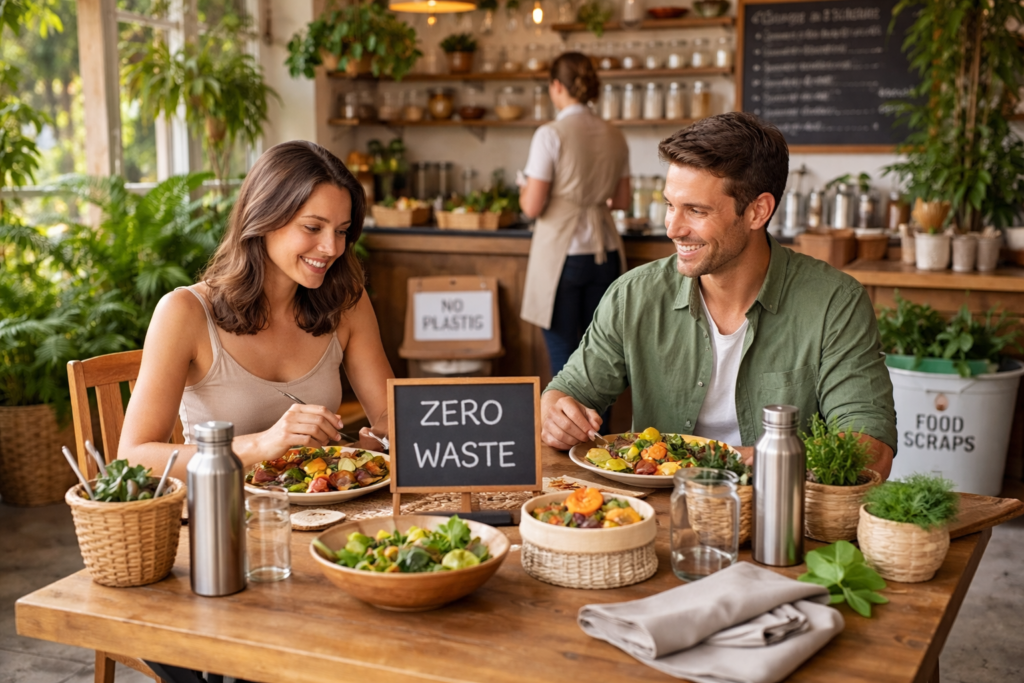

Green food tourism is changing the way individuals travel around the globe very fast. The modern day travellers are not only pursuing flavours but also meaningful and environmentally mindful experiences. Among the most influential tendencies influencing this movement, one can distinguish the appearance of zero-waste restaurants that represent innovative locations and strive to eliminate waste and provide outstanding culinary experiences.
Zero-Waste Dining: What Is It?
Zero-waste dining is a concept that is aimed at minimising or eliminating waste produced in the process of food preparation and service. They are unlike conventional restaurants as these establishments make up their entire system; sourcing of ingredients to serve meals in a manner that has a minimum impact on the environment.
This is not just a concept of minimizing food waste. It has considerate sourcing, efficient kitchen operations, sustainable interiors and even green customer experiences. All the details are well thought through so that nothing ends up in landfills without any reason.
Important Tenets of Zero-Waste Restaurants.
Zero-waste restaurants are run on the basis of a solid sustainability philosophy, which dictates the way these restaurants operate on a daily basis:
- Consumption of local and seasonal food to minimize transport emission.
- Use of ingredients in their entirety by root-to-stem and nose-to-tail cooking.
- Single-use plastics will be eliminated and reusable alternatives will be adopted.
- Recycling food waste into fertile soil.
- Associations with sustainable farmers and suppliers.
- Repurposing by-products to come up with new dishes or ingredients.
These values not only make the food less wasted but also make the process of dining more genuine and conscious of the traveler.
Best Zero-Waste Restaurants in the World.
Silo
Silo in London is considered to be the first zero-waste restaurant in the world. It is based on a closed-loop system in which all are reused or composted. Products are purchased straight off the farm unpacked and even the furniture in the restaurant is constructed out of recycled materials. Eating here is like entering into the future of food sustainability.
Nolla
Nolla or a Finnish word denoting zero is one of the first circular dining establishments. The restaurant is designed in such a way that hardly any waste is wasted in landfills. The suppliers provide the ingredients in reusable containers and the kitchen has advanced composting systems to manage the organic waste effectively. What comes out is an innovative and responsible dining experience.
FREA
FREA in Berlin is a hybrid of vegan food and zero waste. It has its composting machine which converts food scraps into fertilizer which is applied in agriculture. The menu is fully vegetarian and, thus, demonstrates that sustainability and creativity can be used together without affecting the taste.
The Perennial
The Perennial in San Francisco made a permanent mark in sustainable cuisine although it is currently out of business. It brought new ideas such as the ingredients of carbon farming and energy saving methods of cooking that has affected the world at large restaurants and made them go green.
The importance of Sustainable Food Travel.

Food is one of the main components of travel, and it has a great effect on the environment. Transportation to food waste, all these add up to the total carbon footprint. By visiting zero-waste restaurants, one will be able to make a difference and decrease the negative effects on the environment besides contributing to ethical business.
This also promotes local economies. Sustainable restaurants tend to have close relationships with local farmers and suppliers, and this results in fair trade and fresh produce. To the travelers, this translates to having a meal that is not only good but one that has strong ties to the culture and ecosystem.
Where to Find Zero-Waste Restaurants When Travelling.
Zero-waste restaurants are becoming more easily located due to the increasing awareness. Tourists will be able to read about a destination beforehand, browse the sustainability-oriented food blogs, or refer to the apps that point to the presence of eco-friendly restaurants. Social media is also significant, as a large number of restaurants present their sustainability efforts on the internet.
The other efficient method is to look at the practices of restaurants. Restaurants that do not use plastic are frequently in line with the principles of zero-waste, restaurants that feature seasonal menu, or restaurants that emphasize sourcing locally. Hidden gems may also be discovered by asking locals or hotel staff members to recommend them.
Problems of Zero-Waste Restaurants.
Zero-waste restaurants have a number of challenges, even though they have benefits. Sustainable systems may also demand increased investment and good relationships with suppliers. It may be a challenge to be consistent with waste minimization, particularly in the bustling kitchens.
Another challenge is customer awareness. Sustainable practices are not known or appreciated by all diners, and this may make it more difficult to compete with other restaurants. Nevertheless, with the increasing awareness, these issues are slowly being solved.
The Future of Sustainable Food Travel.
Sustainable food travel has a bright future. The demand for zero-waste dining is steadily increasing as more travelers prefer to be eco-conscious in their experience. Sustainability efforts are also being sponsored by governments and organizations, and restaurants are encouraged to be greener.
This future will be determined by innovation. The industry is changing at a high pace with added smart supply chains and advanced composting technologies. Zero-waste dining is not a niche idea anymore but it is a worldwide standard.
Conclusion
Sustainable food travel is reshaping the world experience. Zero-waste restaurants are leading this change and they demonstrate that one can both have outstanding food consumption and save the planet at the same time. With these kinds of dining experiences, travelers will have the ability to make a contribution to a more sustainable future without having to sacrifice on quality or enjoyment.
FAQs
1. What is a zero-waste restaurant?
A zero-waste restaurant is one that aims at reducing waste by sourcing sustainably, cooking efficiently, and recycling or composting food.
2. Do zero-waste restaurants cost a lot?
They will be a bit more expensive because of ethical sourcing, yet they are of higher quality and of more environmental value.
3. Does traveling mean that I can easily find zero-waste restaurants?
Yes, as people become more conscious, numerous cities are now full of environmentally-friendly restaurants that can be found with a single scroll through the Internet.
4. Are zero-waste restaurants exclusively vegan restaurants?
Most, but not all, are shifting to plant based menus since they are more sustainable.
5. What can I do to promote sustainable food travel?
You can contribute to it by eating in eco-friendly restaurants, lessening individual waste, and raising awareness.